
Before leaving my previous job, I was the chair of a disability and mental health network called Enabled at Tesco, where I was able to pursue a mission of advocacy and inclusion alongside my day job. I’m immensely proud of the work I accomplished and miss the role greatly.
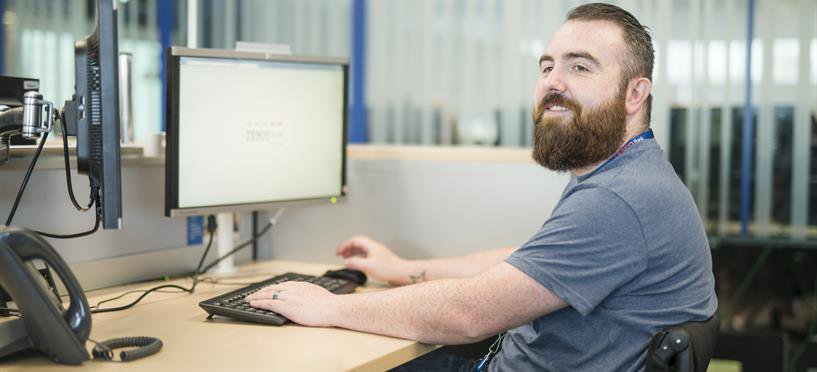
Last-minute panicked photoshoot? Never!
My advocacy journey took me all over the place—to London, Newcastle, and Edinburgh. I attended a fair number of conferences hosted by people with disabilities and companies looking to further their agenda of supporting colleagues with disabilities.
I had the opportunity to meet many wonderful and interesting people, those with various disabilities and those whose lives had been touched by disability.
One particularly memorable conference whisked me away to Edinburgh for some canapés, a networking session, and a panel event.
I witnessed a great talk by Dr Caroline Casey, who enraptured the crowd with her humorous and inspiring stories of growing up with a visual impairment. She was a dynamo and an amazing woman to listen to.

In another segment, there was a Q&A with the head of a particular disability charity, interviewed by another lady.
The host posed the question, “How do you feel about people without disabilities advocating for the rights of the disabled?”
I had no issue with that question; I understood its purpose and found it valid. There are those who are paid handsome salaries to pursue a diversity agenda, and is it right that someone without a disability should campaign for something they potentially have no lived experience of?
That’s a debate for sure.
The interviewee threw back a response: “First of all!” they stated firmly, “We are not ‘The Disabled.’ We are not a homogenised group!”
I found the tone of their reply utterly unnecessary.
The context was clear, and there was no malice in the line of questioning. The harsh response was one that could prompt others to judge and potentially sully the interpretation of the forthcoming dialogue.
The remainder of the response isn’t the focus of this story, but rather the observation that those with disabilities may have particularly strong feelings about the words used to describe them.
On that same stage, that same person mentioned that they preferred the term “impaired,” as society impairs them.
I’d rather be referred to as disabled—short hand for the potential of requiring support or adjustment—than impaired, which I feel suggests that I have a substantial lack of a particular function. However, this is a preference, not a need.
Please don’t take this as ill will toward the interviewee. They have their experiences and good reasons for responding how they saw fit, and I would never seek to censor anyone.

We are all entitled to hold an opinion, even if that opinion is not one everyone agrees with.
I’ll be frank: I have one word that I hate above all, and that is the word “spazzy,” short for “spastic,” solely because it was used as a taunt in high school until I broke and retaliated against my tormentor. I’m not condoning what I did, but it stopped the bullying.
That word is my equivalent to Marty McFly being called “chicken.” If you call me it, I’m swinging at you, and then we’re having a hoverboard chase across town!

This triggering is made only more absurd by the fact that I have a very different disability to the disability the word was previously used to describe, before the word fell out of use for good reason.
The point is, I have a particular distaste for that word due to my own experiences.
However, if you refer to me as disabled, I don’t care. I can be a person with a disability or a disabled person, I don’t take much notice of order of these words as I find it wastes time and energy.
There are those who will fight for the disabled toilet to be referred to as the accessible toilet, that’s not me
I’d rather be given the toilet key than piss myself giving a lecture on the correct name for the room.
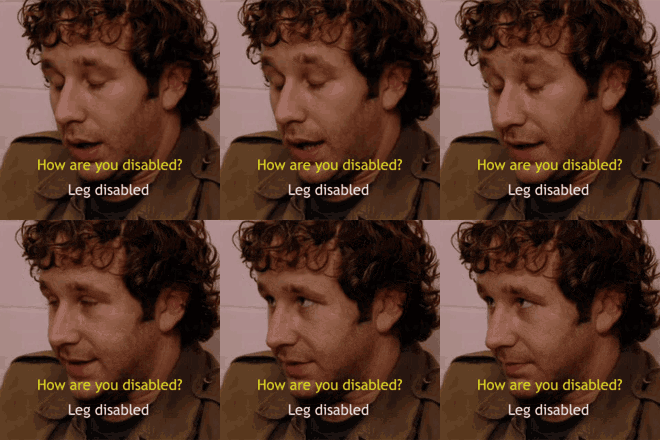
I’d rather use my time wisely and put my efforts into increased accessibility and inclusion than be offended that someone has used an incorrect phrase in my presence.
As long as there is no malice, call me what you need to as long as we get the job done.
Society as a whole has a lot of work to do to ensure those with disabilities are given the same opportunities in life as those without. Let’s bring the focus to where it should be.
 Dystrophy Dad
Another great story. Thank you for sharing, expressing your experiences is relatable in so many ways. Dr. Casey’s TED talk was very “eye opening” (pun intended) Our optimism and VISION are important tools to fight for anything, including physical or mental issues, bullying, racism, your rights, etc. Love the insights, Dept64